
Why Solana Token Tracking Feels Like Treasure Hunting (and How SolScan Helps)
So I was poking around on-chain the other day and got that familiar mix of excitement and mild terror. Whoa! The Solana ledger moves fast. Transactions zip by in milliseconds and wallets blink into existence like roadside diners. My first impression was: this is beautiful chaos. Hmm… the speed is intoxicating, but also, somethin’ felt off—tracking tokens and tracing ownership trails can be messy if you don’t have the right tools.
Here’s the thing. Token trackers are the map you need. Really? Yes. They turn the raw ledger into something you can read. Medium-level analytics show token flows, and deep analytics reveal concentration risks and abnormal patterns. Initially I thought a basic explorer would do. But then realized that nuanced on-chain analysis requires specialized features—transfer graphs, richer metadata, token mint histories, and program-level tracing. On one hand the data’s all there. On the other hand it’s buried in transactions and program logs—though actually, with the right explorer, that noise becomes a narrative.
Let me be honest—I’m biased toward tools that make complex data feel simple. I’m also a bit of a rules person (yeah, boring). But I value glimpses into user behavior and token economics more than vanity metrics. The part that bugs me is when people equate high transaction count with true adoption. That’s not the same thing. So we’ll walk through practical ways to track tokens on Solana, how to read analytics, and why the the right explorer matters. Also, I’ll point you to a resource I use often, the solscan explorer official site, because it’s a solid combination of raw query power and nice UX—no hard sell, just my experience.
Why token tracking matters. Short answer: visibility. Medium answer: liquidity and trust. Long answer: if you want to evaluate a project’s tokenomics, detect rug pulls, trace airdrops, or reconcile cross-program transfers, you need clear historical records and the ability to pivot quickly between high-level dashboards and low-level transaction logs. Sometimes the red flags are obvious—huge one-off transfers to anonymous wallets. Other times it’s subtle—gradual accumulation in a set of accounts that never sells, which can signal staking or controlled liquidity. The nuance is where your instincts meet data, and that’s fun… and a little scary.
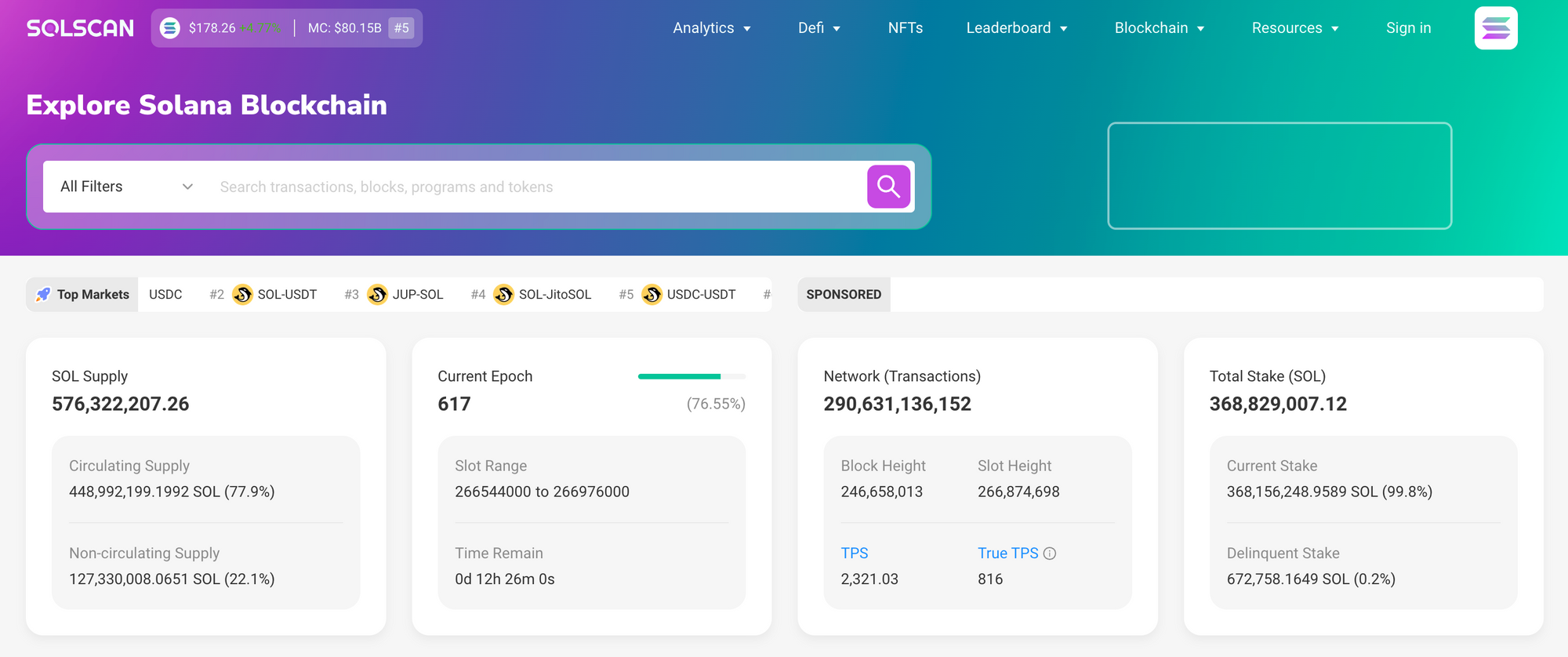
How token trackers work on Solana (practical primer)
Token trackers index token accounts and mint data. They connect the dots between token mints, token accounts, and associated transactions. Simple explanation: every SPL token has a mint. Each wallet that holds that token has a token account tied to the mint. Trackers collect those accounts, watch transfers, and aggregate metrics like total supply, circulating supply, largest holders, and transfer volume. Short bursts help: Wow! It’s that neat.
Operationally, a strong explorer does several things well. First, it keeps an up-to-date index of token accounts and mints. Second, it parses transaction instructions so you can see which program handled the transfer (token program, Serum, Raydium, a custom program). Third, it surfaces historical snapshots for holder distribution at various times. And yes—advanced explorers also parse memos and decode metadata (useful for NFTs and off-chain links). Initially I thought all explorers offered parity. Actually, wait—some do a far better job normalizing program instruction data, which makes forensic work much faster.
Practical tip: when you look at a token page, check these first: total supply, number of holders, top holder share, and recent large transfers. If a small number of wallets control a huge share, that increases centralization risk. If you see a pattern of tokens moving to exchange deposit addresses, that might be real selling pressure—or it might be market-making. Context matters. Also, check for token burns and mint authority changes—those are governance signals. Hmm… sometimes those little authority flips are the most revealing.
Analytics features to love. Some features are “nice-to-have” and others are “can’t live without.” I love holder concentration charts (Lorenz curves), time-series volume, and transfer heatmaps. Really? Yes. Transfer heatmaps show where transfers cluster by value or time-of-day. Liquidity pool interactions are another must—being able to see which AMMs a token appears in, and how deep those pools are, helps gauge market resilience. Advanced viewers let you filter transfers by program and by source/destination labels, which saves hours of manual tracing.
Okay, here’s an example scenario. You’re evaluating a new token. First scan the mint page for basic stats. Second, check the top 20 holders and map their wallet creation dates. Third, trace the largest inbound and outbound transfers in the last 72 hours. Fourth, look for interactions with known exchange or bridge addresses. If big transfers culminate at a bridge, that could presage cross-chain liquidity shifts. If funds hit exchange deposit addresses, expect volatility. These steps are repeatable and surprisingly effective.
Security and on-chain forensics. Token trackers are invaluable during incidents. Suppose a smart contract bug led to unauthorized minting. A good explorer can show the mint event, trace tokens to recipient wallets, and track where those tokens went next. Sometimes you find that stolen tokens pass through a mixing pattern—small transfers to many accounts—while other times it’s a fast hop to a custody address. The ability to follow that breadcrumb trail is the difference between “we lost funds” and “we recovered context.” I’m not 100% sure how far you can recover in every case, but traceability always helps.
Integration with wallets and tools. The best explorers are wallet-friendly. They allow you to paste a wallet address and instantly view token balances (with token prices), recent transfers, and program interactions. Many support CSV export for on-chain accounting. Oh, and if you use analytics stacks or BI tools, some explorers provide APIs so you can pull raw indexed data into your own dashboards. I’m biased toward solutions that let me download a holder snapshot and run my own filters offline—sometimes the UI just doesn’t cut it for deep dives.
Common pitfalls and how to avoid them. Don’t conflate holder count with active users. Don’t assume tokens in exchange deposit addresses are instant sell signals. Watch for layered program transfers—tokens wrapped in derivatives or LP tokens can hide underlying movements. Also, be careful with token metadata—some projects omit or misconfigure metadata which makes token discovery harder. And yeah, somethin’ about token names being similar can trick you; double-check the mint address before you act.
Workflow for analysts. I keep a small checklist when I evaluate a token: verify mint, snapshot holders, trace top transfers, check program interactions, label common addresses, and export data for further analysis. Repeat. Over time you build a mental library of “normal” vs “suspicious” patterns. Initially I thought this would be tedious. But then realized that pattern recognition gets easier, and you start seeing red flags earlier. You get better at connecting the dots—though you’ll still miss a weird edge case now and then…
Common questions about token tracking
How do I confirm a token’s authenticity?
Check the token’s mint address and associated metadata. Confirm the on-chain metadata if available, and compare token symbols and decimals. Cross-reference the mint with official project channels, and look for known wallets (team treasury, verified exchange addresses). If the the project publishes a contract address, make sure it matches the mint. Also, watch for tiny mint anomalies—unexpected decimal settings or misconfigured authorities.
Can I detect wash trading or fake volume on Solana?
Yes, partly. Look for circular transfers between a small set of wallets, repeated high-frequency swaps that return tokens to origin wallets, and transfers that occur at odd intervals. Use holder and transfer clustering to identify potential wash networks. It’s not foolproof, but patterns jump out once you know what to look for.
Which explorer should I rely on?
There isn’t a single perfect tool. I use multiple explorers depending on the task. For quick token checks and a friendly UI, I often start with the solscan explorer official site because it balances depth and usability. For heavy forensic work, I sometimes pair that with raw RPC queries or custom indexers. I’m biased, but mixing tools reduces single-source blind spots.